Stephen T. Sandler, D.D.S.,

Verona Smiles

Call Us Today

(973) 857-1326

Menu
  • Home
  • About Us
    • Mission Statement
    • Meet The Team
      • Dr. Stephen Sandler
      • Maria
    • Our Practice
    • Our Technology
      • Digital X- Ray
      • Intraoral Camera
      • Logicon Software
      • Soft Tissue Laser
      • Rotary Endodontics
      • L.E.D. VELSCOPE -LX
  • Services
    • Preventive & periodontal Health
      • Periodontal Treatment
      • Scaling & Root Planing
      • Arestin
      • Occlusal Adjustment
      • Periodontal Splinting ( Weak Teeth)
      • Oral Cancer Screenings
      • Preventive Care
      • Periodontal (gum) disease
      • Sealants
    • Cosmetic Dentistry
      • Lumineers
      • Porcelain Veneers
      • Teeth Whitening
    • Endodontics
      • Root Canal
      • Retreatment
    • Restorative Dentistry
      • Implants
      • Dental Implant FAQ’s
      • Crowns
      • Tooth Colored Fillings
      • Bridges
      • Dentures
    • Orthodontics
      • Clear Correct Bracers
    • Other
      • TMJ Treatment
      • Night Guards
      • Sleep Apnea
  • Concerns / Fears
    • Light Oral Sedation (Anxiolysis)
    • Hypnosis for Dental Phobia
    • Nitrous Oxide
  • Hypnotherapy
    • About hypnosis
    • Hypnosis Quiz
    • Hypnosis in the News
  • Patient Resources
    • Print Patient Registration
    • Smile Gallery
    • FAQs
      • Dental Implant FAQ’s
    • Post-Op Instructions
      • Root Canal Therapy
      • Crowns & Bridges
      • White Fillings (Bonding)
      • Scaling & Root Planing
      • Veneers
      • Extractions
    • AGD Facts
      • Early Discovery of Oral Cancer
      • HPV and Oral Cancer
      • Laser Focus
      • Brushing Basics
      • Preventing Tooth Erosion
      • Protect Your Children's Teeth
      • Your Baby's Oral Health
      • Your Child's First Dental Visit
      • Don't Forget to Floss
      • Cosmetic Dentistry
      • Dental Sealant
      • Prevention for Children
      • Root Canal
      • TMJ
      • Wisdom Teeth
      • Best Food For Kids
      • Mouth Guards
      • Mouth Guards & Head Injuries
      • General Dentists
    • Newsletter
    • Educational Videos
    • Links
  • Financial Options
    • Online Payment
    • Carecredit
  • Contact Us
  • Home >
  • Articles >
  • Oral Surgery >
  • Cleft Lip and Palate

Cleft Lip and Palate

  • Created in Oral Surgery

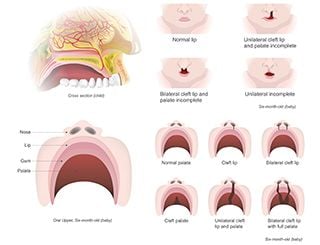
cleft lipA cleft lip and cleft palate are common birth defects that occur in the very early stages of fetal development. A cleft lip is the separation of the two sides of your child’s upper lip, appearing as a narrow or wide opening that can extend to the roof of the mouth. A cleft palate is a split or opening in the roof of your child’s mouth. These abnormalities can occur separately or together, and can vary in severity. Surgery is the only way to repair a cleft lip or cleft palate.

Problems Associated with Cleft Lip and Palate

Cleft lip and palate repair does a lot more for your child than cosmetically correcting their appearance. Surgery helps restore proper function to your child’s lips and mouth. Cleft lips and palates are also associated with health and developmental problems such as hearing loss, dental issues, and speech issues. With cleft lip and palate surgery, your child will be able to eat, drink, breathe, hear, and speak normally as they develop.

Cleft Lip Surgery

Cleft lip surgery is recommended between three and six months of age. Once your baby is under general anesthesia for the procedure, the surgeon will begin by making incisions on either side of the cleft lip to create flaps of skin. These two pieces are drawn together to close the gap of the birth defect and then sewn together with dissolvable stitches. Cleft lip surgery typically takes less than two hours. Your baby will spend the night in the hospital to make sure that they have tolerated surgery well.

Cleft Palate Surgery

Cleft palate surgery is usually performed when your child is around 12 months old. General anesthesia is used again for this type of procedure. Once your child has fallen asleep, the surgeon will make incisions on either side of the palate, loosening layers of tissue so that they can be stretched over the separation. When the tissue is placed where it needs to be, dissolvable stitches will be used to hold everything in place. Cleft palate surgery takes between two and three hours, though longer depending on the type and severity of the cleft palate. A second surgery in the future may be required to fully repair a cleft palate.

Your child will fully recover from cleft lip or palate repair in about four weeks. Due to the complexity of cleft palate surgery, recovery may take a little longer.

  • Educational Videos
  • Cosmetic & General Dentistry
  • Emergency Care
  • Endodontics
  • Implant Dentistry
  • Oral Health
  • Oral Hygiene
  • Oral Surgery
  • Orthodontics
  • Pediatric Dentistry
  • Periodontal Therapy
  • Technology

Contact Us

Send Us an Email

Error!

    Featured Services

    Click to find out more

    • Meet The Team

      Click here to learn more about us!
      Learn More
    • About Us

      Learn more about us!
      Learn More
    • Contact Us Today

      we encourage you to contact us via phone or email!
      Learn More

    Hours of Operation

    Our Regular Schedule

    Monday:

    11:00 am-8:00 pm

    Tuesday:

    8:00 am-2:00 pm

    Wednesday:

    Closed

    Thursday:

    8:00 am-5:00 pm

    Friday:

    8:00 am-2:00 pm

    Saturday:

    By Appointments only.

    Sunday:

    Closed

    CONNECT WITH US

    Our Location

    Find us on the map

    • Copyright © 2026 MH Sub I, LLC dba Officite.
    • Admin Log In
    • Site Map