Missing teeth impact not only appearance, but oral health as well. If you’ve lost some or all of your teeth because of trauma, periodontal infection, or decay, dentures are one of the options that can offer you a healthier, more attractive smile. Full or partial dentures:
- Make eating and chewing easier
- Facilitate clearer speech
- Provide support for cheeks and lips for a healthier, more youthful appearance
- In the case of partial dentures, prevent remaining teeth from shifting out of place
- Restore self-confidence
- Create a natural-looking smile
Your dentist will examine your gums, jawbone, and remaining teeth to determine whether dentures are your best option for tooth replacement, and which type of full or partial denture will best suit your needs. Custom dentures are individually crafted in specialized labs in a variety of different materials. Suitability, durability, aesthetic, and cost considerations can all be factors in your decision.
Full Dentures
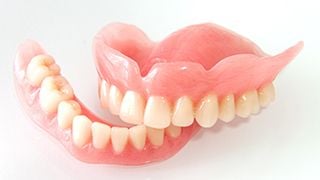 Full dentures replace all of the teeth on the upper and/or lower jaw. For all types of full dentures, detailed impressions and measurements will be taken of your gums and mouth to create an ideal fit. The way your jaws work together will be evaluated to ensure that your dentures won’t affect your bite. Your dentist will also consider the shape of your face and your lips for a natural-looking, aesthetically pleasing smile.
- Conventional Dentures
Conventional full dentures are created after the gums and jawbone have healed post-extraction, which usually requires several months. Temporary dentures can be used during the healing period.
- Immediate Dentures
These dentures are fabricated in advance before any necessary extractions occur, and can be placed right away, without waiting for the gums and bone to heal. Because the gums and jawbone can shrink after tooth loss, it might take several months of adjustments to create the most comfortable fit. Immediate dentures are often used as a temporary denture.
- Implant-Supported Dentures
Dental implants are first surgically placed in the jawbone where they fuse with the bone over a period of months. Once the implants are secure, removable dentures are fabricated that clip onto the implants. (Fixed dentures are also an option, attached to the implants using special screws which can only be removed by a dentist.) This type of denture is very secure, and, because implants stimulate jawbone tissue like natural tooth roots do, helps prevent bone loss.
Partial Dentures
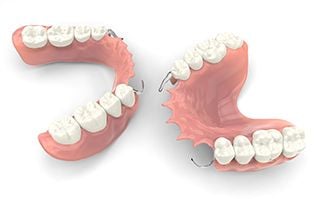 Partial dentures replace multiple missing teeth in the upper or lower jaw. Most of them require healthy adjacent teeth for secure placement. Unlike bridges, which are fixed permanently to adjacent teeth, partial dentures are removable and are held in place with different types of attachments:
- Clasp Attachments
A common form of partial denture has a metal clasp attached to the end of the denture that fits snugly around a supporting tooth, holding it securely in place. These clasps are sometimes visible when speaking or smiling.
- Precision Attachments
Small interlocking metal parts on both the partial denture and the adjacent teeth connect together for an unobtrusive, secure fit. These dentures might require crowns for the adjacent teeth and can be more expensive than clasp attachments.
- Flexible Partial Dentures
Made of thermoplastic material, flexible dentures use translucent, gum-colored extensions that discreetly fit around the base of the teeth near the gumline.
- Implant-Supported Partial Dentures
Partial dentures use stud or clip attachments to hold the denture securely to the dental implants.
Denture Care
Dentures, like natural teeth, require daily care. Your dentist can recommend the type of cleaning routine, soft brush, non-abrasive cleaner, and soaking solution that is best for removing any plaque and bacteria that build up on the denture.
Any discomfort or any damage to the appliance should be reported to your dentist at once. Keep up with regular dental checkups to make sure your denture is fitting properly and that your gums and other oral tissues are healthy.
Whether you choose dentures, bridges, or implants, replacing missing teeth restores the function and transforms the appearance of your smile. To discover if dentures are the best choice for you, discuss your questions, concerns, and options with your dentist.